
Solar systems with batteries: how they are designed
Here we look at the architecture of a system that includes storage: how the battery connects to the panels and the inverter, what can be added to an existing system and how the configuration differs according to the consumption profile. For details about the battery as a product, see the page about batteries.
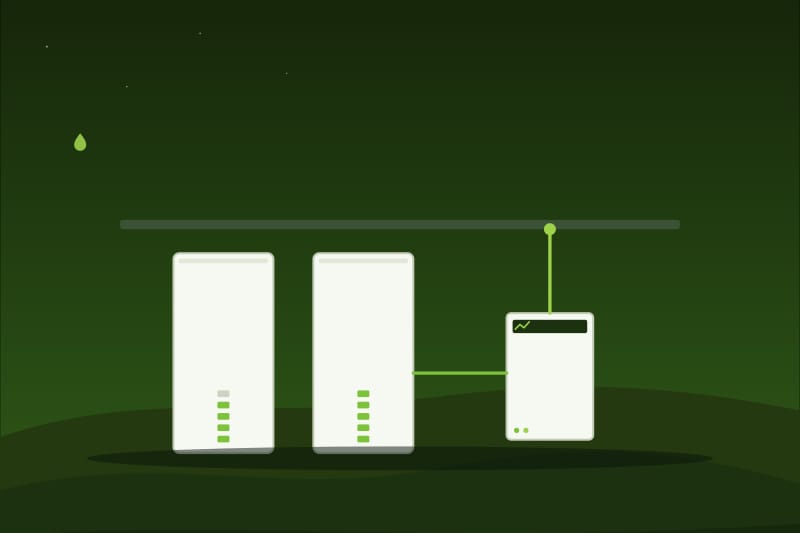
Direct-current or alternating-current coupling
With direct-current (DC) coupling, the battery connects to the same hybrid inverter as the panels, and the energy goes through a single conversion. With alternating-current (AC) coupling, the battery has its own inverter-charger and connects to the house’s electrical installation. The first option is common in new projects; the second is often used to add storage to an existing system.
- DC coupling: a compact architecture, fewer conversions, a single central unit;
- AC coupling: flexibility for systems already installed, but with an extra piece of equipment and additional conversion losses.
Adding a battery to an existing system
If you already have panels, the type of inverter determines the options. A storage-ready inverter allows the battery to be added directly; otherwise AC coupling can be used, or the inverter can be replaced. We check the data of the existing equipment, the consumer unit and the grid connection arrangement before making a proposal.
The backup circuit
Backup during a power cut requires a specific configuration: a dedicated output, a distribution board for the essential loads and switchover rules. Without these, the battery works only for self-consumption. We choose the backup loads together with you, so as not to oversize the installation. The principle is also explained on hybrid solar systems.
Three consumption profiles, three approaches
A family who work in town
Low consumption during the day, high in the evening. The battery matters a lot for self-consumption, and its size is based on evening consumption.
A home with someone in during the day
Many appliances run while the system is producing. A system without a battery, or with a small one, can already cover a large part of consumption.
A smallholding with a water pump or a workshop
Consumption has high power peaks. Here the power of the inverter and of the battery matters too, not just the capacity, and some loads can be shifted in time.
Expanding in stages
A system can be built in stages: first the panels and the inverter, then the battery. It is worth choosing a storage-ready inverter and a consumer unit prepared for the future from the start, to avoid costly changes.
See also
Useful articles
Frequently asked questions
Can a battery be added after the panels are installed?
Yes, in many cases, through AC coupling or by replacing the inverter. It depends on the existing equipment.
What is DC coupling?
The battery connects to the same hybrid inverter as the panels, on the direct-current side.
Does a battery make sense if I do not have power cuts?
It can, for self-consumption, if you use a lot of energy in the evening. It depends on your consumption habits and on the configuration of the system.
Shall we talk about your project?
Tell us your town and roughly how much you use. We will suggest the next steps.